ABOUT US
GaneshAID is a women-led humanist consultancy dedicated to saving more lives in low- and middle-income countries.
Our organization specializes in improving global health while respecting ethical and humanistic principles.
We are proud to support organizations and governments in developing practical, innovative approaches to solve persistent problems of inequity and low health coverage. Together with its partners, GaneshAID provides knowledge on trends in innovations and provides new ideas that support the strategic agenda of organizations, governments, and communities.
We pay particular attention to the needs of vulnerable populations, while ensuring that the proposed solutions are not only focused on economic efficiency or technical management, but also integrate values such as human dignity, equitable access to care, and community participation.
For more information, please visit:
Our website: https://ganeshaid.com/en/
Our LinkedIn page: https://www.linkedin.com/company/ganeshaid/
ABOUT THE PROJECT
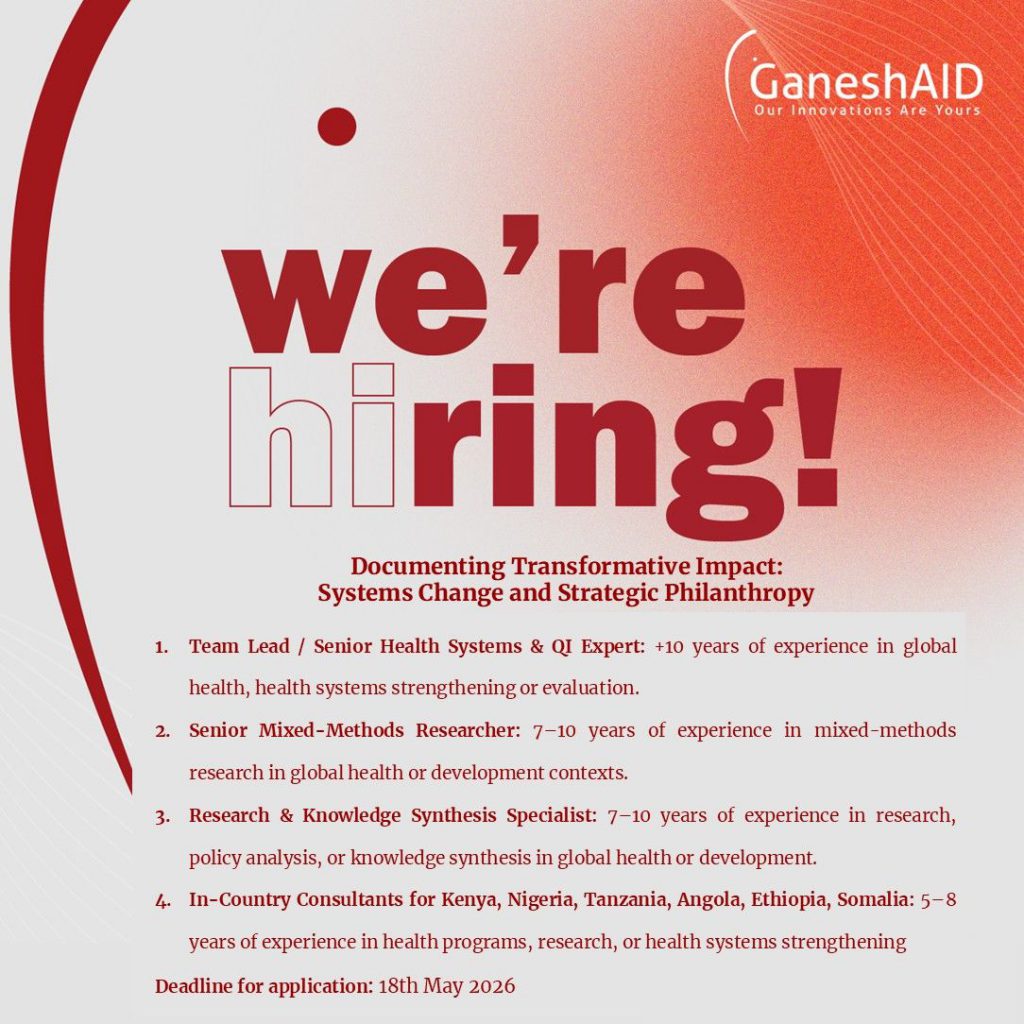
This multi-country assignment will document the transformative impact of Quality Improvement-driven health systems strengthening across Kenya, Nigeria, Tanzania, Angola, Ethiopia, and Somalia. The project will generate high-quality evidence, case studies, and learning products that capture systems change, strategic philanthropy outcomes, and practical lessons for policy, donor, and academic audiences. It will involve mixed-methods research, cross-country analysis, stakeholder engagement, and knowledge synthesis to highlight how QI approaches contribute to stronger, more responsive health systems.
Position: Team Lead / Senior Health Systems & QI Expert
Provide overall technical leadership and strategic direction for a multi-country assignment documenting the impact of Quality Improvement (QI)-driven health systems strengthening across Kenya, Nigeria, Tanzania, Angola, Ethiopia, and Somalia. The Team Lead will ensure methodological rigour, coherence across analytical components, and production of high-quality learning outputs tailored to policy, donor, and academic audiences. The role will position findings within the Global Fund’s Resilient and Sustainable Systems for Health (RSSH) agenda and broader integrated service delivery priorities across HIV, TB, malaria, and MNCH.
Documenting Transformative Impact: Systems Change and Strategic Philanthropy
Key Responsibilities
- Lead inception phase, including refinement of methodology, analytical framework, and workplan aligned with the Terms of Reference
- Provide overall technical oversight across all components, including:
- Analysis of secondary programme data and QI indicators
- Design and oversight of qualitative inquiry (key informant interviews, case studies)
- Cross-country comparative synthesis of findings
- Development of policy-relevant learning outputs and dissemination materials
- Ensure methodological coherence and quality assurance across all deliverables
- Guide identification of system-level enablers, bottlenecks, and scale-up pathways for integrated QI approaches
- Supervise and coordinate multidisciplinary team members, ensuring clear division of roles and efficient delivery
- Lead engagement with the Global Fund (RSSH and Grant Management Division), national stakeholders, and implementing partners
- Oversee development of high-quality outputs, including case studies, policy briefs, and peer-reviewed manuscripts
- Ensure outputs are tailored for multiple audiences (policy-makers, donors, academia) and aligned with dissemination opportunities (e.g., global fora)
- Provide strategic guidance on positioning findings within global health systems strengthening and corporate philanthropy narratives
Qualifications
Education
- Advanced degree (Master’s or PhD) in Public Health, Health Systems, Epidemiology, or related field
Professional Experience
- Minimum 10 years of progressively responsible experience in global health, health systems strengthening, or evaluation
- Demonstrated experience leading multi-country research, evaluation, or learning assignments
- Strong experience with Quality Improvement (QI) approaches and integrated service delivery models
- Proven experience engaging with international organisations (e.g., Global Fund, WHO, UNICEF) and government stakeholders
- Track record of producing policy-relevant outputs and/or peer-reviewed publications
- Experience working in Sub-Saharan Africa strongly preferred
Skills and Competencies
- Strong leadership and coordination of multidisciplinary teams across countries
- Deep understanding of health systems strengthening and QI methodologies
- Ability to synthesise complex, multi-source evidence into clear, actionable insights
- Strong stakeholder engagement and facilitation skills across global and country levels
- Excellent analytical, writing, and quality assurance capabilities
- Ability to translate evidence into outputs suitable for policy and donor audiences
Language Requirements
- Fluency in English required
- Working proficiency in languages relevant to project countries (e.g., Portuguese, Amharic, Somali, Swahili) is an asset, or demonstrated ability to work effectively through local partners and interpreters
Location and Availability
- Duty station: Remote, with intermittent travel to project countries as required
- Duration: June 2026 – April 2028
- Availability: Intermittent but sustained engagement across all phases (inception, analysis, synthesis, dissemination)
Position: Senior Mixed-Methods Researcher
Role Summary
Lead the design and implementation of mixed-methods research underpinning a multi-country analysis of Quality Improvement (QI)-driven health systems strengthening. The Senior Mixed-Methods Researcher will integrate quantitative analysis of secondary programme data with qualitative insights from interviews and case studies, ensuring robust triangulation and analytical credibility. The role will contribute directly to the development of high-quality, publishable outputs targeting policy and academic audiences.
Key Responsibilities
- Design and implement the mixed-methods research approach, aligned with the approved analytical framework
- Lead analysis of secondary programme data, including service delivery indicators and QI metrics
- Design qualitative tools (interview guides, case study frameworks) and ensure consistency across countries
- Guide country consultants in conducting interviews and documenting case studies
- Conduct qualitative data analysis, including coding and thematic synthesis
- Integrate quantitative and qualitative findings through systematic triangulation
- Contribute to identification of cross-country trends, system-level enablers, and bottlenecks
- Provide substantive analytical inputs into case studies, policy briefs, and synthesis reports
- Contribute to development of peer-reviewed manuscripts and ensure outputs meet publication standards
- Ensure data quality, integrity, and adherence to ethical research standards
Qualifications
Education
- Advanced degree (Master’s or PhD) in Public Health, Epidemiology, Social Sciences, Health Economics, or related field
Professional Experience
- Minimum 7–10 years of experience in mixed-methods research in global health or development contexts
- Demonstrated experience analysing secondary health programme data
- Proven experience designing and implementing qualitative research, including interviews and case studies
- Experience working across multiple countries, preferably in Sub-Saharan Africa
- Familiarity with health systems strengthening and/or Quality Improvement approaches preferred
- Demonstrated authorship or co-authorship of peer-reviewed publications relevant to global health, health systems, or evaluation
Skills and Competencies
- Strong quantitative and qualitative analytical skills
- Proficiency in analytical tools (e.g., Excel, Stata, SPSS, R, NVivo or similar)
- Ability to integrate diverse data sources into coherent analytical narratives
- Strong attention to methodological rigour and data quality
- Ability to support distributed teams and ensure consistency in data collection
- Excellent academic writing skills and familiarity with publication standards
Language Requirements
- Fluency in English required
- Working proficiency in languages relevant to project countries (e.g., Portuguese, Amharic, Somali, Swahili) is an asset, or demonstrated ability to work effectively through local partners and interpreters
Location and Availability
- Duty station: Remote, with limited travel as required
- Duration: June 2026 – April 2028
- Availability: Sustained engagement across design, analysis, and synthesis phases
Position: Research & Knowledge Synthesis Specialist
Role Summary
Lead the synthesis of multi-country evidence into coherent, policy-relevant insights on Quality Improvement (QI)-driven health systems strengthening. The Research & Knowledge Synthesis Specialist will consolidate findings from quantitative analysis, qualitative inquiry, and document review to produce structured analytical outputs. The role will ensure that cross-country learning is clearly articulated and aligned with Global Fund priorities on integrated service delivery and health systems resilience.
Key Responsibilities
- Lead comprehensive document review of programme materials, national strategies, and QI learning resources
- Synthesise findings from multiple data sources, including:
- Secondary programme data analysis
- Qualitative interviews and case studies
- Country-specific documentation and reports
- Develop structured analytical frameworks for cross-country comparison
- Identify patterns, trends, and system-level enablers and bottlenecks across countries
- Support development of comparative case studies, including selection and framing of representative examples
- Translate technical findings into clear, structured inputs for policy briefs, synthesis reports, and manuscripts
- Work closely with the Senior Mixed-Methods Researcher to ensure analytical consistency and rigour
- Contribute to drafting of cross-country synthesis paper and other key deliverables
- Ensure outputs are tailored to different audiences, including policy-makers, donors, and academic stakeholders
Qualifications
Education
- Advanced degree (Master’s or PhD) in Public Health, Health Policy, Development Studies, or related field
Professional Experience
- Minimum 7–10 years of experience in research, policy analysis, or knowledge synthesis in global health or development
- Demonstrated experience conducting document reviews and synthesising complex, multi-source information
- Experience working on multi-country assignments or comparative analyses
- Familiarity with health systems strengthening and/or Quality Improvement approaches preferred
- Demonstrated authorship or co-authorship of peer-reviewed publications or high-quality analytical reports relevant to global health or policy
Skills and Competencies
- Ability to work collaboratively within a multidisciplinary team
- Strong analytical and synthesis skills across qualitative and quantitative inputs
- Ability to structure complex information into clear, actionable insights
- Experience with comparative analysis and cross-country learning frameworks
- Excellent writing skills for technical and policy audiences
- Strong attention to detail and quality assurance
Language Requirements
- Working proficiency in languages relevant to project countries (e.g., Portuguese, Amharic, Somali, Swahili) is an asset, or demonstrated ability to work effectively through local partners and interpreters
- Fluency in English required
Location and Availability
- Availability: Sustained engagement during document review, analysis, and synthesis phases
- Duty station: Remote
- Duration: June 2026 – April 2028
NOTE
The outcome of these recruitments is contingent on contract award.
HOW TO JOIN?
Interested applicants are kindly requested to complete the application form via the following link.
Please click here to apply. Due to the high volume of applications, only shortlisted candidates will be contacted. We appreciate your understanding.
GaneshAID values diversity and welcomes applicants of all backgrounds, as we believe that different perspectives and experiences enrich our work and enable us to better serve the communities we work with.
