ABOUT US
GaneshAID is a women-led humanist consultancy dedicated to saving more lives in low- and middle-income countries.
Our organization specializes in improving global health while respecting ethical and humanistic principles.
We are proud to support organizations and governments in developing practical, innovative approaches to solve persistent problems of inequity and low health coverage. Together with its partners, GaneshAID provides knowledge on trends in innovations and provides new ideas that support the strategic agenda of organizations, governments, and communities.
We pay particular attention to the needs of vulnerable populations, while ensuring that the proposed solutions are not only focused on economic efficiency or technical management, but also integrate values such as human dignity, equitable access to care, and community participation.
For more information, please visit:
Our website: https://ganeshaid.com/en/
Our LinkedIn page: https://www.linkedin.com/company/ganeshaid/
ABOUT THE PROJECT
This project will support national and regional efforts to improve emergency communication, community engagement, health information use, and preparedness for public health risks. data collection, and field reporting to strengthen last mile supply chain performance.
POSITION: Team Lead / Senior RCCE Expert
Role Summary
Provide overall technical leadership and strategic direction for the Risk Communication and Community Engagement (RCCE) capacity strengthening programme in Uganda. The Team Lead will ensure quality delivery across all workstreams, maintain alignment with national RCCE priorities, and oversee coordination with key stakeholders.
Key Responsibilities
- Lead inception, work planning, and programme design in line with MoH RCCE strategy and decentralised cascade model
- Provide technical oversight across all workstreams, including:
- RCCE training package development and delivery
- Community engagement systems strengthening (including parish-level structures and ICHBC)
- Call centre strengthening and evidence generation
- Ensure quality assurance of training materials, facilitation approaches, and cascade implementation
- Supervise and coordinate multidisciplinary team members, ensuring integration across technical areas
- Lead engagement with MoH (DHPEC, Community Health, Division of Health Information), and partners
- Oversee documentation of results, lessons learned, and final reporting
- Provide strategic guidance on infodemic management, community feedback systems, and RCCE best practice
Qualifications:
Education
• Advanced university degree (Master’s or higher) in Public Health, Communication for Development, Social/Behavioural Sciences, or related field
Professional Experience
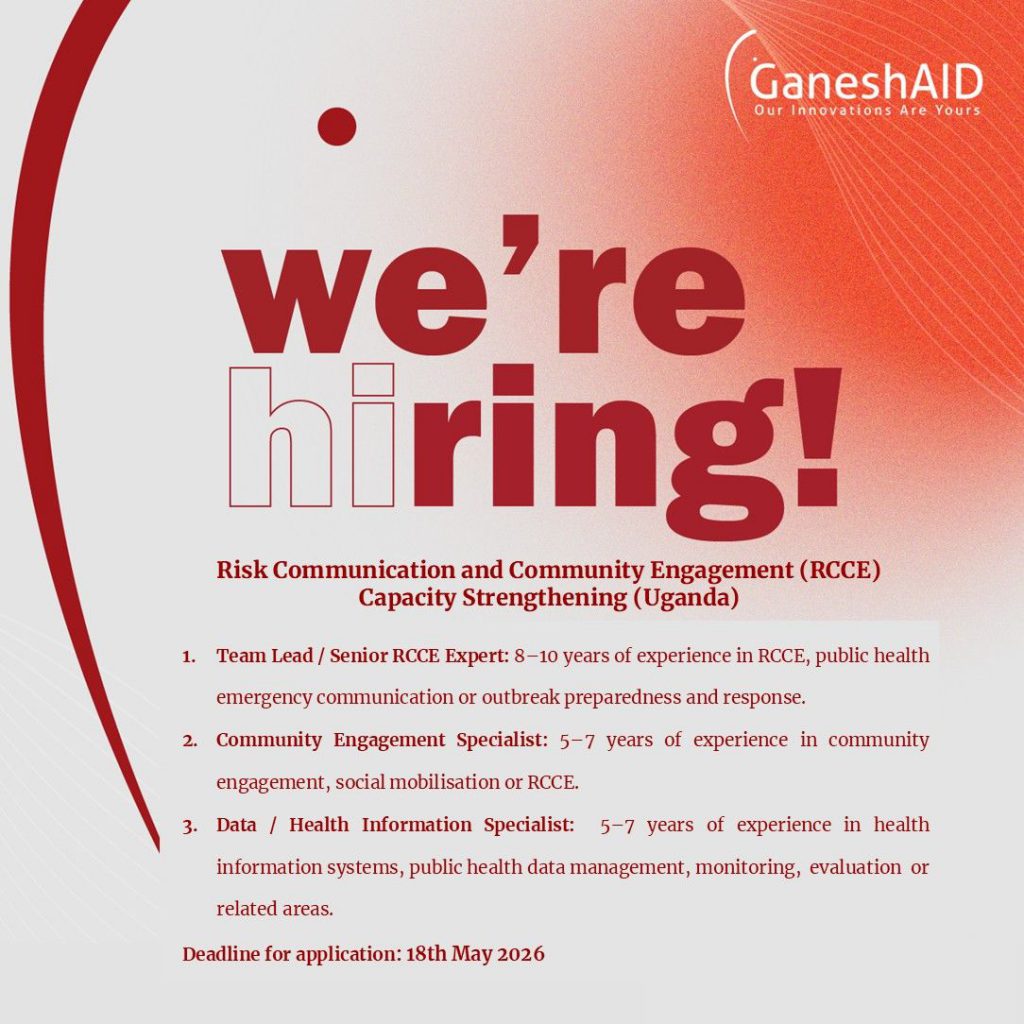
- Minimum 8–10 years of progressively responsible experience in RCCE, public health emergency communication, or outbreak preparedness and response
- Demonstrated experience leading large-scale, multi-region or national-level programmes
- Proven experience working with government health systems, preferably in Sub-Saharan Africa
- Strong track record in designing and overseeing capacity building and cascade training models.
Skills and Competencies
- Strong strategic leadership and programme management capability
- Deep technical expertise in RCCE, community engagement, and risk communication
- Ability to integrate behavioural, community, and data-driven approaches
- Excellent stakeholder coordination and facilitation skills
- Strong analytical, reporting, and quality assurance skills
Language Requirements
- Fluency in English required
- Knowledge of relevant Ugandan local languages is an asset
Location and Availability
- Duty station: Uganda (Kampala-based coordination with travel to regions as required)
- Indicative duration: Approximately 4–5 months (June – September/October 2026)
- Start date: Expected June 2026 (subject to contracting timelines)
- Availability: Full-time or near full-time engagement required during key delivery phases (inception, ToT, supervision)
- Modality: Hybrid acceptable, with regular in-country presence required at key milestones
- Note: The timeline is aligned to the ToR (May–August 2026); actual implementation may commence later and extend accordingly
Position: Community Engagement Specialist
Role Summary
Lead the design and implementation of community engagement approaches for the Risk Communication and Community Engagement (RCCE) capacity strengthening programme in Uganda, with a focus on strengthening parish-level systems, supporting Integrated Community and Home-Based Care (ICHBC), and ensuring effective linkage between communities and RCCE structures across all 17 regions.
Key Responsibilities
- Design and operationalise community engagement components of the RCCE programme
- Support development and dissemination of integrated community engagement guidelines and tools
- Lead capacity building for Parish Social Service Committees and community-level actors
- Support implementation and scale-up of ICHBC approaches
- Ensure integration of:
- Community feedback mechanisms
- Inclusion of vulnerable and hard-to-reach populations
- Trust-building and behaviour change approaches
- Provide technical support during district cascade training, mentoring, and supportive supervision
- Contribute to documentation of lessons learned, good practices, and community-level outcomes
Qualifications
Education
- University degree in Public Health, Social Sciences, Development Studies, Communication, or related field (Master’s preferred)
Professional Experience
- Minimum 5–7 years of relevant experience in community engagement, social mobilisation, or RCCE
- Demonstrated experience working with community governance structures (parish, village, or equivalent)
- Experience in outbreak response, health promotion, or community-based programming
- Proven experience in training design, facilitation, and field-level implementation
- Prior experience in Uganda or similar contexts strongly preferred
Skills and Competencies
- Strong understanding of community systems and decentralised service delivery
- Practical experience in facilitating community engagement and behaviour change processes
- Ability to work effectively with local government, civil society, and community actors
- Strong interpersonal and facilitation skills
- Ability to translate technical guidance into practical, field-ready tools
Language Requirements
- Fluency in English required
- Proficiency in one or more Ugandan local languages strongly preferred
- Location and Availability
- Duty station: Uganda (Kampala with extensive travel to regions and districts)
- Indicative duration: Approximately 4–5 months (June – September/October 2026)
- Start date: Expected June 2026 (subject to contracting timelines)
- Availability: Full-time engagement required, including travel across assigned regions
- Modality: Primarily in-country, field-based
- Note: The timeline is aligned to the ToR (May–August 2026); actual implementation may commence later and extend accordingly
Position: Data / Health Information Specialist
Role Summary
Provide technical leadership and operational support for data management, health information systems, and evidence generation components of the Risk Communication and Community Engagement (RCCE) capacity strengthening programme in Uganda.The specialist will support strengthening of call centre systems, qualitative data analysis, community feedback mechanisms, and reporting processes to inform RCCE planning and decision-making.
Key Responsibilities
- Support the design and implementation of data management and reporting systems for the RCCE programme
- Provide technical support for strengthening call centre operations, feedback systems, and information flows
- Lead qualitative and quantitative data analysis related to community feedback, rumours, perceptions, and behavioural insights
- Support integration of community feedback and evidence into RCCE planning, decision-making, and adaptive programming
- Develop data collection, analysis, visualisation, and reporting tools for programme monitoring and documentation
- Support monitoring, evaluation, and learning processes across programme activities and regions
- Ensure data quality assurance, consistency, and timely reporting across implementation sites
- Contribute to training and mentoring of relevant personnel on data management, analysis, and reporting tools
- Support preparation of technical reports, presentations, dashboards, and evidence summaries for MoH, and partners
- Collaborate closely with MoH Division of Health Information, DHPEC, and other technical teams to strengthen evidence-informed RCCE implementation
Qualifications
Education
- Advanced university degree (Master’s preferred) in Public Health, Health Informatics, Biostatistics, Epidemiology, Data Science, Health Information Systems, Monitoring and Evaluation, or related field
Professional Experience
- Minimum 5–7 years of relevant professional experience in health information systems, public health data management, monitoring and evaluation, or related areas
- Demonstrated experience supporting data systems for public health, outbreak response, RCCE, or community-based programmes
- Experience in qualitative and quantitative data analysis, including community feedback and behavioural insights
- Experience supporting call centre systems, feedback mechanisms, or digital reporting platforms is an advantage
- Proven experience working with government health systems and multi-stakeholder programmes
Skills and Competencies
- Strong analytical and problem-solving skills
- Proficiency in data management, analysis, and visualisation tools (e.g. Excel, Power BI, DHIS2, Kobo Toolbox, SPSS, STATA, or similar)
- Strong understanding of public health information systems and data quality assurance processes
- Ability to synthesise complex data into actionable insights and user-friendly reports
- Strong coordination and communication skills, with ability to work across multidisciplinary teams
- Attention to detail and ability to manage multiple reporting timelines simultaneously
Language Requirements
- Fluency in English required
- Knowledge of relevant Ugandan local languages is an asset
Location and Availability
- Duty station: Uganda (Kampala-based coordination with travel to regions as required)
- Indicative duration: Approximately 4–5 months (June – September/October 2026)
- Start date: Expected June 2026 (subject to contracting timelines)
- Availability: Full-time engagement required during key implementation, reporting, and supervision phases
- Modality: Hybrid acceptable, with regular in-country presence required during key activities
- Note: The timeline is aligned to the ToR (May–August 2026); actual implementation may commence later and extend accordingly
NOTE
The outcome of these recruitments is contingent on contract award.
HOW TO JOIN?
Interested applicants are kindly requested to complete the application form via the following link.
Please click here to apply. Due to the high volume of applications, only shortlisted candidates will be contacted. We appreciate your understanding.
GaneshAID values diversity and welcomes applicants of all backgrounds, as we believe that different perspectives and experiences enrich our work and enable us to better serve the communities we work with.