
ABOUT US
GaneshAID is a women-led humanist consultancy dedicated to saving more lives in low- and middle-income countries.
Our organization specializes in improving global health, while respecting ethical and humanistic principles.
We are proud to support organizations and governments in developing practical innovative approaches to solve persistent problems of inequity and low health coverage. Together with its partners, GaneshAID provides knowledge on trends in innovations and provides new ideas that support the strategic agenda of organizations, governments, and communities.
We pay particular attention to the needs of vulnerable populations, while ensuring that the proposed solutions are not only focused on economic efficiency or technical management, but also integrate values such as human dignity, equitable access to care, and community participation.
For more information, please visit:
Our website: https://ganeshaid.com/en/
Our LinkedIn page: https://www.linkedin.com/company/ganeshaid/
ABOUT THE PROJECT
This assignment supports a multi-country initiative aimed at strengthening primary health care systems and advancing digital health readiness across several Pacific Island countries. The project involves conducting an integrated landscape analysis to assess health system foundations, workforce capacity, governance arrangements, and digital infrastructure, with the objective of identifying priority gaps, feasibility considerations, and sequencing recommendations. The work will inform future investments in digital health, telehealth, workforce development, and regional coordination mechanisms to enhance service delivery and system resilience.
Project: PHIT Integrated Landscape Analysis
Location: Fiji, Kiribati, Tonga, and Tuvalu (with in-country travel as required)
Duration: March-April 2026, 10–12 weeks maximum
Reporting to: Programme Director
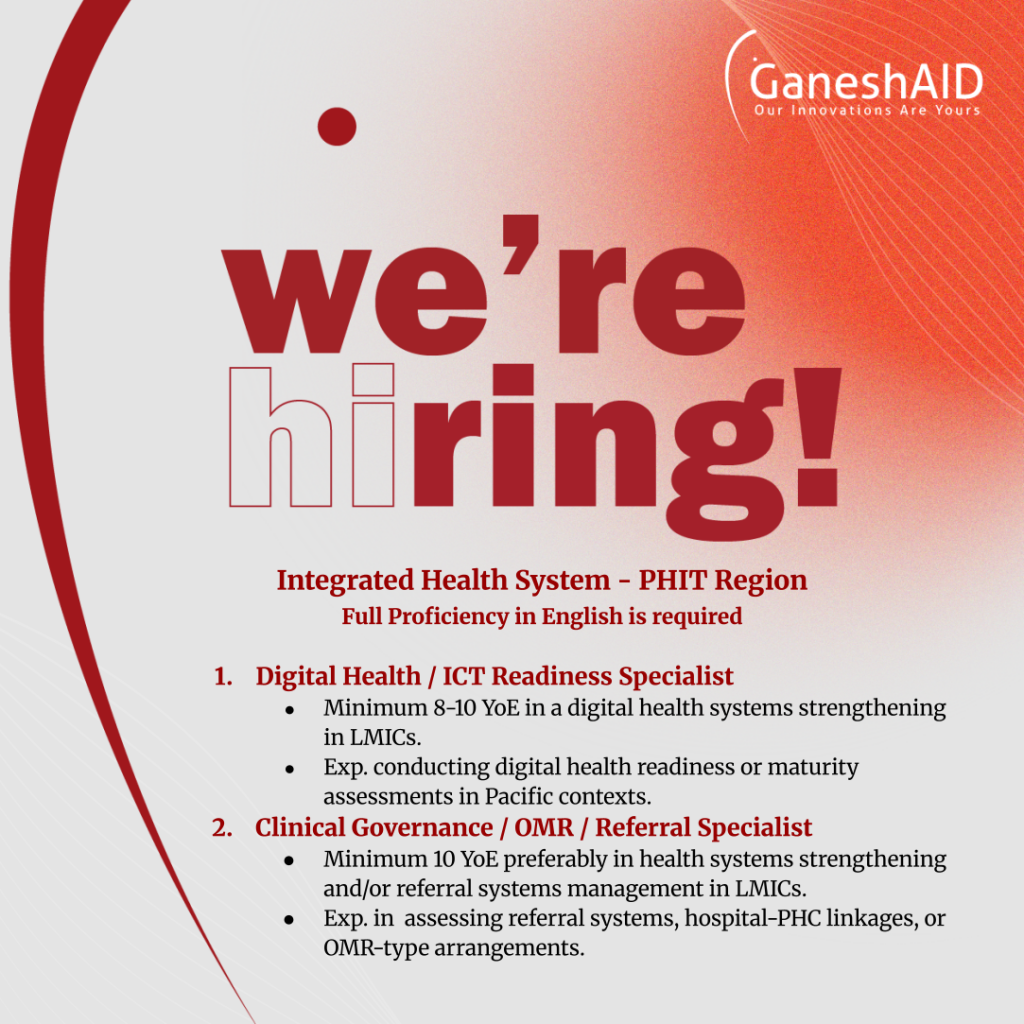
1. Digital Health / ICT Readiness Specialist
Role Purpose
To lead the digital health readiness assessment component of the PHIT integrated landscape analysis, ensuring robust evaluation of digital infrastructure, governance, interoperability readiness, and policy/legal constraints, and contributing to integrated sequencing recommendations.
The role focuses on readiness assessment and feasibility analysis, not system architecture design or procurement specification.
Tentative Responsibilities
A. Digital Landscape Mapping
- Map existing digital health systems and platforms in Fiji, Kiribati, Tonga and Tuvalu (e.g., EMRs, LMIS, workforce registries, telehealth platforms, AI-enabled applications).
- Assess institutional ownership, vendor ecosystem, and operational sustainability arrangements.
- Identify duplication, fragmentation, and integration gaps.
B. Infrastructure and Enabling Environment
- Assess digital infrastructure constraints (connectivity, power reliability, hosting environment).
- Review digital governance frameworks, including data stewardship, privacy, consent, cybersecurity, and cross-border data flows.
- Conduct high-level AI and cybersecurity readiness review relevant to PHIT use cases.
C. Feasibility and Risk Assessment
- Analyse feasibility of PHIT-relevant digital enablers (e.g., LMS, regional registry, telehealth network).
- Identify prerequisites and dependencies between digital investments and health system reforms.
- Classify bottlenecks as non-digital, digitally enabled, or digital-dependent (with Team Lead).
D. Integration and Reporting
- Draft country and regional digital readiness snapshots.
- Contribute to mandatory synthesis and sequencing chapter.
- Participate in validation consultations with governments and partners.
Required Qualifications
- Advanced degree (Master’s or above) in Digital Health, Health Informatics, ICT for Development, Public Health with digital specialization, or related field.
- Minimum 8–10 years of experience in digital health systems strengthening in LMICs.
- Demonstrated experience conducting digital health readiness or maturity assessments.
- Experience assessing policy, legal, governance, and interoperability frameworks.
- Strong analytical writing skills and ability to produce concise, decision-oriented outputs.
- Experience working with governments and UN or multilateral partners.
Required Experience
- Multi-country assignments involving digital health ecosystem mapping.
- Assessment of infrastructure and connectivity constraints in resource-limited settings.
- Engagement with ministries on data governance, interoperability, and digital strategy.
- Familiarity with telehealth platforms, workforce registries, and digital learning systems.
- Experience contributing to strategic sequencing or investment prioritisation exercises.
Core Competencies
- Systems thinking across health and digital domains.
- Ability to translate technical digital issues into policy-relevant recommendations.
- Risk identification and mitigation framing.
- Stakeholder facilitation and consultation skills.
- Ability to work under compressed timelines.
Preferred Attributes
- Experience in Small Island Developing States (SIDS) or Pacific contexts.
- Familiarity with regional public goods or cross-border digital governance.
- Prior experience supporting UNICEF, WHO, or development banks.
Languages
Required: English (professional fluency).
Desirable: Experience working in Pacific contexts; familiarity with regional working environments is advantageous, though Pacific languages are not mandatory.
Preferred Location of Residence
- Based in Pacific region, Southeast Asia, or Australia/New Zealand strongly preferred.
- Remote candidates considered, provided availability for virtual consultations and potential short in-country missions.
2. Clinical Governance / OMR / Referral Specialist
Role Purpose
To lead the assessment of clinical governance, referral pathways, and Overseas Medical Referral (OMR) systems across the four participating countries, identifying priority gaps affecting continuity of care, quality, and cost-efficiency, and informing sequencing recommendations.
The role focuses on analysis and systems mapping, not development of new clinical protocols.
Tentative Responsibilities
A. Referral Pathway Mapping
- Map referral pathways between PHC and higher-level services.
- Assess standard operating procedures and documentation practices.
- Identify bottlenecks affecting quality and continuity of care.
B. Overseas Medical Referral (OMR) Review
- Analyse OMR processes, documentation, clinical governance oversight, and feedback loops.
- Assess implications for cost, equity, and clinical outcomes.
- Identify cross-border care governance issues relevant to regional coordination.
C. Clinical Governance Assessment
- Review quality assurance mechanisms at PHC and referral levels.
- Assess supervision, documentation standards, and accountability mechanisms.
- Identify regulatory and governance constraints affecting safe telehealth and cross-border referral.
D. Integration and Reporting
- Draft country-level summaries on referral and governance constraints.
- Contribute to integrated synthesis and sequencing logic.
- Participate in validation workshops and government consultations.
Required Qualifications
- Medical degree or advanced qualification in Public Health, Health Systems, or Clinical Governance.
- Minimum 10 years of experience in health systems strengthening and/or referral systems management in LMICs.
- Demonstrated experience assessing referral systems, hospital-PHC linkages, or OMR-type arrangements.
- Experience working with ministries of health on governance or service delivery reform.
Required Experience
- Review or reform of referral pathways in resource-constrained settings.
- Clinical documentation systems and continuity-of-care mechanisms.
- Quality assurance or clinical governance systems at the national or subnational level.
- Engagement in policy discussions involving cross-border care or specialist referral.
Core Competencies
- Deep understanding of PHC service delivery and referral dynamics.
- Ability to identify systemic bottlenecks affecting quality and efficiency.
- Capacity to analyse governance and accountability structures.
- Clear and structured policy-oriented writing.
- Strong stakeholder engagement and facilitation skills.
Preferred Attributes
- Experience in Pacific Island countries or other SIDS contexts.
- Familiarity with telehealth integration into referral pathways.
- Experience working with UNICEF, WHO, or similar partners.
- Understanding of NCD management pathways in small health systems.
Languages
Required: English (professional fluency).
Desirable: Experience working in Pacific environments; familiarity with regional health governance settings is advantageous.
Preferred Location of Residence
- Pacific region or prior experience in Pacific/SIDS strongly preferred.
- Availability for short-term travel to participating countries if required.
NOTE
The outcome of these recruitments will be determined following the approval of GaneshAID’s proposal.
HOW TO JOIN?
Interested applicants are kindly requested to complete the application form via the following link.
Please click here to apply. Shortlisted candidates will be contacted for further evaluation.
GaneshAID values diversity and welcomes applicants of all backgrounds, as we believe that different perspectives and experiences enrich our work and enable us to better serve the communities we work with.

 EN
EN  FR
FR